The phrase Outdoor Education (OE) is used often to define learning in the outdoor environment with a predetermined curriculum and objectives. In Singapore, OE is used mostly by the education system that manages the primary school to tertiary age (7 years old and above), whereas Outdoor Learning is the term used for Early Childhood education in Singapore (0-6 years old). For the purpose of this paper, I will use Outdoor Education as the overarching term for both OE and OL.
But what exactly is Outdoor Education? How should we define it? At what stage do we say it is NOT Outdoor Education?
Let’s break down the words first, to deep dive and explore their meaning.
OUTDOORS
Outdoors is described as the external environment that is separate from home and the internal sheltered environment. In the outdoors, we are susceptible to the elements of the weather and wilderness. There is an inherent colonial language used here, in the dichotomic way we separate the living experience of one in terms of outdoor and indoor. It’s very different from the various indigenous languages that often describe the living experiences without putting lines to seperate them.
The outdoors also presents an element of real risk that is often linked to our survival instinct. In the outdoors, where we face many elements, the possibilities of potential fatality are real. Our natural instincts take over to keep us alive in the outdoors. The absence and disconnection from what is natural can lead to consequences. However, the energy that we gain from these risk laced experiences, are what make living truly meaningful to our biological, mental and spiritual body. We all know the lifting energy we get from “getting some air” outside. We are part of Nature… no?
Through the elements of the outdoors we experience independence and interdependence through a sphere of seemingly random yet well interwoven connections.
Independence is experienced outdoors by one’s sense of awareness, that they need to carry their own weight and resources. They need to be aware of their own capability, to survive and bring energy to living. This independence is relevant to living on earth in terms of survival and flourishing.
Interdependence comes in when we pay attention to the environment, the resources and dangers they present. We experience the challenges of the outdoors, and find ourselves naturally building relationships with the different environmental elements, to survive and thrive. Interdependence is experienced and realised in a way that is natural – because we need the environment, not because we want it. The outdoors allows interconnections to forge because ecosystems of Nature thrive by living together.
Understanding these, we can see Outdoors not just as a separate entity to Indoors, but an integral part of the human experience to be alive on earth. It is an experience not just a resource.
EDUCATION
Education here is described as learning and growth, through a building of capacity. It is about raising the awareness and intellect of an individual to create a metacognitive ability that will then lead to living with energy in life.
Many may see Education in modern language as a preparation for working and performing. It is a part of what Education means, but it is also too simplistic in essence. Because when one stops being Educational about life, one loses the curiosity and energy to live life. Life is not just about working and performing, it is also about living, connecting and raising our capability to thrive and survive.
Education comes with it the element of learning through a space of curiosity. One learns when they are curious. The energy of curiosity creates a carnival of opportunities to raise the awareness and intellect of an individual.
In Education, growth is represented through the building of the capacity of an individual as they learn and experience the journey of Education. The growth is an expression of the existing innate potential that usually already exists in an individual.
Understanding these, we can see Education not as some transactional experience, but a multi-woven web of space and potential that expresses itself when ignited by curiosity and realisations.
OUTDOOR EDUCATION
When we weave these deep dives into the meaning of the words, we arrive at the energetically derived meaning of Outdoor Education.
Outdoor Education is the expression of the potential of individuals, communities, and environment through their learning and growth from the experience of living, surviving, and thriving with an environment that interweaves independence and connection through her climate of wilderness.
“Outdoor Education stems from the need to atone the sin of Indoorisation…”
– Selima Negro
Today, in the modern-day Singapore context, Outdoor Education faces challenges that ties in closely with the dichotomous definition of ‘Outdoors’ and the transactional definition of ‘Education’.
MODERN CHALLENGES
When we separate ourselves from the living body of the environment, and take a transactional approach to learning and growth, we will arrive with a much more disconnected spiral of interaction across the sphere of Outdoor Education practice.
Outdoor Education in Singapore is often undermined as an add-on to the existing transactional elements of knowledge in the Education industry. It is not seen as a living experience that we all have regardless of where we are.
Some versions of Outdoor Education are even systematically mocked, for not meeting any modern-day neuro and cognitive goals. Though if you understand the deep dive explained above, you could see that this judgement has a very poor basis, because Outdoor Education often develops the cognitive potential even more than the Indoorisational Classes.
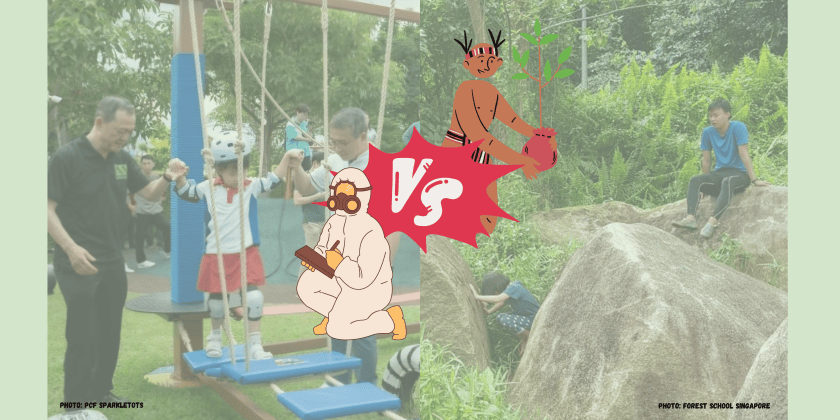
Outdoor Education is also often misunderstood as a sphere where people do survival bushcraft skills, camping skills and adventure skills. When actually, these are just some of the platforms and practices. There are many more approaches involved like Forest School, Heritage Walks, Environmental Studies etc. The foundation of the ecosystem is experience, learning and growth. In a way many things can fall into this sphere. It is almost infinite.
The illnesses of Indoorisations also add on to the challenges of exercising Outdoor Education.
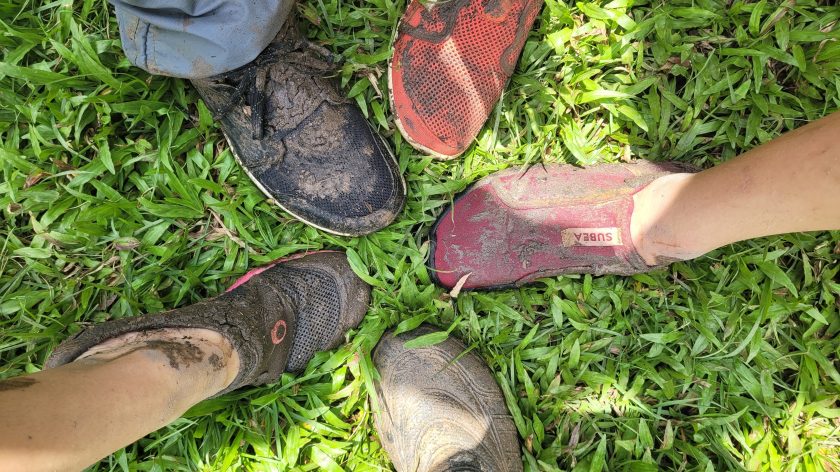
Through the administering of Indoorisations, the modern indoor populations develop imagined realities of what they coin as “Dirty”. Mud and Soil (the foundational elements of living) are defined as dirty in the eyes of many adults when instructing children to avoid interacting with these life-giving elements. These kinds of imagined realities create a mental and paradigm resistance to even taking the step into having Outdoor Education.
We also live in the modern world where the selling of convenience is so ingrained in us, that most people wholeheartedly believe in its benefit 100%. The natural inconvenience but beneficial effect of Outdoor Education becomes a hard seller when competing against the modern sin of sloth by convenience.
Facing all the insurmountable challenges of the Modern Indoorised World, many folks would have taken the easy road to comply and fall in line. But not the passionate OE educators in the world.
The educators of the OE world, keep on ploughing for what they believe in. Through the multiple administrative, cultural, and paradigm challenges, they keep going. They know that it may not bring them the highest glory and riches. Some even have to deal with incidents of fatalities or near fatalities. But they still continue with heart and rigour, not because they want to just cover their backside. It is because they love the work and people they have impacted. They know the risk, they know the liabilities, they know the difficulties. But they know that the magic of Outdoor Education goes beyond the transactional and dichotomic world. I’m honored to meet many of them in Singapore and around the World.
Their life is Outdoor Education. They are the essence of OE, through the way they express their life.
Outdoor Education is … …
Written by : Darren Quek
Edited by : Zoe Xu & Ilya Katrinada

