
These are Reflection notes from Samantha Tan (@askteachersam) about the recent Early Childhood Development Agency’s Conference 2025, which she sent to the Parents of her kuriosoasis playmates…
PART 1
“Dear Parents, Sam here. 🙂 I just attended ECDA’s Conference and would like to share some insights from a Plenary Session regarding transition to primary school for preschoolers. Please read this, and feel free to forward it to your friends with young children.”
Plenary Session
(Partners in Transition: Preschool to Primary School)
Dr Mercy Karuniah Jesuvadian
(Senior Lecturer at NIE, Psychology and Child & Human Development)
Mrs Sharon Siew
(Principal of Jing Shan Primary School, MOE)
Ms Stacey Toh
(ECDA Fellow, Deputy Head, Preschools, Star Learners Group)
Mr Kelvin Soh
(Chairperson of Parent Support Group, Queenstown Primary School)
Dr Mercy’s Sharing
Transition really focuses on how to reduce anxiety and fear.
Successful Transition = Emotionally, psychologically, intellectually settled
The most crucial skill to acquire before primary school so children are well transitioned: Socio Emotional Skills
Self regulation, adaptability and managing social relationships (They need this, most children who are well transitioned are children who have acquired these dispositions)
Interestingly, they did not mention academic readiness.
Their response to not talking about academic readiness: “Somethings we don’t get quite right, no matter how well resourced the primary school is, when the socio and emotional needs of the child is not met, they are not able to adapt nor learn effectively”
Sam’s reflection: There are many studies done in the very recent years that all share the same message. There is an urgent need for children to play more — this looks like free play, conflicts, problem solving and creative play. Time spent with parents. However much time you have, if you are able to do so, you’re preparing your children well for an uncertain future, where information and answers are so easily retrieved with AI. Why is there an urgent need? It has been found that a lack of play time and relationships can be extremely detrimental for children’s mental health. Play more! That is truly the way to go.
PART 2
Dear Parents, This is a primary school principal’s sharing about children’s behaviour and shifts in primary school happening right now. 🙂
Sharon’s sharing of some shifts in the primary school
1. A more invitational approach that the school may adopt (Inviting parents to share more bout their children)
If you begin to wonder why your teachers are asking you to share more about your child, there is a need to share information, as often as possible. Information is power.
Principals of the school have to engage parents to say, “parents, share information with your teachers” It is extremely valuable for parents to speak to their leaders and teachers.
Be assured that you are on the same team as your teachers/leaders.
2. On the topic of HOMEWORK and the importance of reading (to read, to be read to, to read with)
P1 and P2 there is minimal homework, no remedial lessons in the afternoon.
[“good practices”] What do they do in the afternoon? Read.
The culture of reading is being ramped up in the education system. (This does not mean we ask children to read by themselves, it involves the parents too! Reading TO them and reading WITH them) Don’t be too hung up on homework, be more hung up on fostering a culture of reading and reflection.
Sam’s reflection: Try to adopt a habit to visit libraries, read with your children at bedtime/anytime. If you children are very averse to reading, try to evoke a sense of curiosity for it. That may look like you “pretending” that you’ve read something exciting on your phone (if a book is not accessible), then reading the text together with your children. If you would like more strategies to help with cultivating a joy for reading, please let me know! I will be happy to share more.
3. Parents are a “mirror” to their child
They mirror your anxiety, it rubs off on the child.
Sam’s reflection: Watch how you are reacting to primary school and the thoughts you verbalise.
4. Connecting with the Gen Alpha learners.
They are a generation who have gone through a full pandemic. The pandemic has made changes to their lifestyle and behaviours. A caveat here: Kids are all good kids but this is the observation,
It’s much more challenging to establish routines, to settle children down and listen. It’s harder for them to understand the concept of delayed gratification. With technology, you don’t like something they just swipe, perhaps there is some blame to screen time too. A positive difference is that they are often more confident and able to express their views, but they won’t wait their turn nor do they filter their thoughts. Children these days don’t lean towards stretches of hard work..
5. She has also told parents and preschool teachers, DO NOT go and buy primary school preparation books because it’s not going to do good for your child. When the child comes into school overly prepared, they are going to be very very bored, They are gonna go “Been there, done that”. It robs the child’s anticipation for new learning and the joy of discovering new things with their peers!! Don’t do it too excessively.
Sam’s reflection: There are many strategies to help them with impulse control, executive function of attention, memory and understand empathy, respect, persistence and collaborative values, please let me know if you’d like me to share more! Regarding point 5, know that children will learn, the worst thing that could happen is that they develop a resistance to learning, they no longer feel joy learning.
PART 3
Ms Stacey Toh
Key difference between preschool and primary school. There is nap time, it’s a smaller ratio, classrooms are designed differently from primary schools. These are changes that children will have to go through.
Kelvin shared that in preschool we teach children to be kind, that they should share etc. Kelvin’s son came back to buy all the erasers from the bookstore and gave them out to his classmates, solely because he was “taught to share”.
Sam’s reflection and relating back to KO: This is kind of the moral learning that children are also navigating as they enter primary school and there are ways to help children learn through these experiences. This reminds me of really identifying what your child has experienced or will experience in future. What do they already know. Play once again, allows children to better understand morals/ social development. A suggestion I’d have, let them spend time with you when you are in your own friend groups, tell them explicitly what you like and what you don’t like.. what makes sense to your family culture and what doesn’t.. 🙂
PART 4
What are the primary schools turning to right now for transition and how are their priorities shifting.
Adaptations in primary school for transitions
1. Induction programmes, buddy systems, establishing routines.. These are not new, and are still in-force.
Note! They saw a need to move forward with greater emphasis on well being and social emotional competencies. Throughout out the levels, journeying with the child.
2. The use of positive psychology to engage children. More and more, schools are talking about wellbeing and cultivating a sense of gratitude. Gratitude practices can be done every single day. Questions like, who do you want to thank? Why do you want to thank them? Cultivating a culture of gratitude as a way of life. If you practice gratitude on a day to day basis, it will evoke very positive emotions in you. This creates a rather positive cycle of thought and wellness in general.
3. Celebrating effort and active participations, Do not celebrate results. It will evoke a sense of accomplishment in the child, when the child feels accomplished, the child will have a sense of overall wellbeing.
Sam’s reflection: Do note that it is a real problem when children are introduced to grades very early on and how it can possibly affect their sense of self-worth. Please celebrate progress and effort than the results 🙂 More and more researchers are studying childhood depression. This is why there is a new urgent need for all organisations working with children to begin shifting and evolving their practices to protect children.
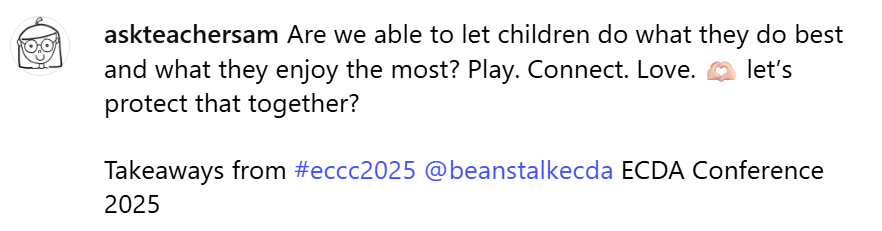
You can find the above Reflections in her IG post below…
Written by : Samantha Tan

